Navigating the financial landscape of a divorce is often one of the most daunting and complex parts of ending a marriage. If you’re facing this process, understanding the specific laws that govern asset and debt distribution is critical to protecting your financial future. In Washington, property division adheres to the principles of community property, a system that, while seemingly straightforward, carries nuances that can significantly impact your final settlement. Getting to grips with these rules is essential, whether you’re focused on securing a fair parenting plan with your custody lawyer Spokane or you are specifically strategizing over asset protection.
I. The Foundation of Division: Community vs. Separate Property
Washington State is one of only a handful of states that operate under community property law. This system provides the baseline for how all assets and debts are categorized during a divorce.
I.A. Defining Community Property
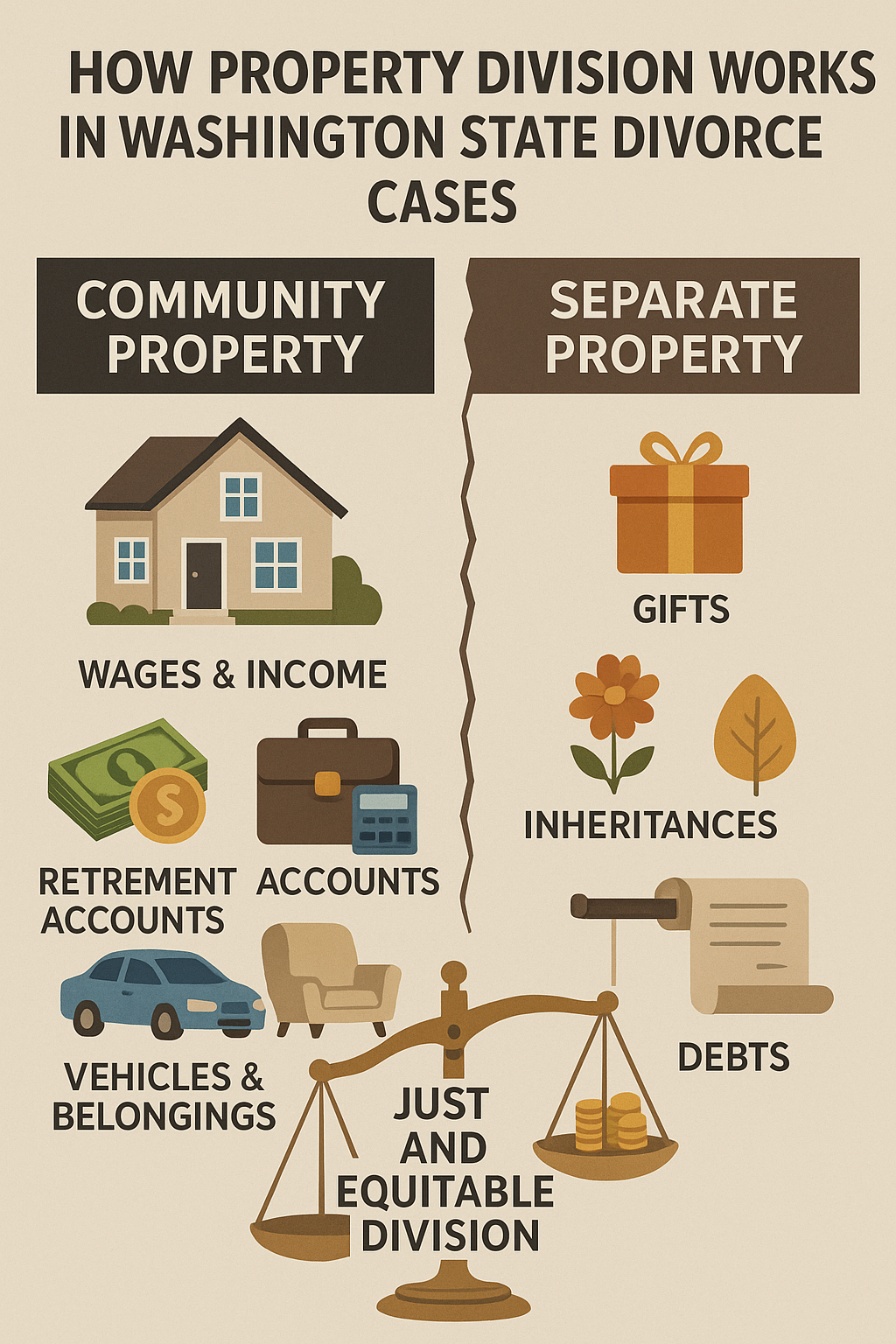
Community property includes all assets and debts that either spouse acquired from the date of marriage until the date of separation. It doesn’t matter whose name is on the title or who earned the income; if it was acquired during the marriage, it belongs equally to both spouses.
Examples of community property include:
- Wages, salaries, and income earned by either spouse.
- The marital home, if purchased during the marriage.
- Retirement accounts, 401(k)s, and pensions accrued during the marriage.
- Vehicles, furniture, and personal belongings bought during the marriage.
- Debts, such as mortgages, car loans, and credit card balances incurred during the marriage.
I.B. Defining Separate Property
Separate property is anything owned by a spouse before the marriage. Crucially, it also includes gifts or inheritances received by one spouse alone, even if received during the marriage.
Separate property generally remains the property of the spouse who owns it and is not subject to division in a divorce. However, the court has the authority to consider separate property when determining a final “just and equitable” distribution of all assets and debts, especially in long-term marriages.
I.C. The Peril of Commingling Assets
A common challenge is when separate property loses its character by being commingled with community property. If a spouse inherits a large sum of money (separate property) and deposits it into a joint checking account used to pay the mortgage and household bills (community property), those funds become so mixed that they can be difficult, if not impossible, to trace. Without meticulous documentation to trace the separate funds, the court may rule that the entire amount has been converted into community property, making it subject to division.
II. The Guiding Principle: “Just and Equitable” Division
While Washington is a community property state, it is not strictly a 50/50 division state. The law requires a just and equitable distribution of all property and liabilities.
II.A. What “Just and Equitable” Truly Means
For most short- to medium-term marriages, “just and equitable” often translates into a roughly equal (50/50) split of the community estate. However, the court has broad discretion to award a disproportionate share of the assets to one spouse if the circumstances warrant it. This means the court must ensure the final division is fair, even if it is unequal.
II.B. Factors the Court Considers for Disproportionate Awards
When a judge deviates from a 50/50 division or awards a portion of one spouse’s separate property to the other, they must base the decision on the following factors outlined in the Revised Code of Washington:
- The nature and extent of the community property.
- The nature and extent of the separate property.
- The duration of the marriage.
- The economic circumstances of each spouse at the time the division becomes effective. This is often the most impactful factor, considering age, health, future earning capacity, and custody arrangements.
For example, in a long-term marriage where one spouse sacrificed their career to raise children and has little retirement savings, a judge may award them a larger share of the community assets to help compensate for their significantly lower future earning potential.
III. The Process of Valuation and Discovery
Before property can be divided, it must be accurately identified and valued. This process, known as discovery, is essential, especially in contested cases.
III.A. Mandatory Financial Disclosure
Both parties are legally required to provide a complete and accurate declaration of all assets and liabilities. This includes providing tax returns, bank statements, retirement records, and debt statements. Failing to disclose assets can result in serious penalties, including the judge awarding the entire value of the hidden asset to the other spouse.
III.B. Valuing Complex Assets
Simple assets like bank accounts and publicly traded stocks are easy to value. Complex assets require specialized expertise:
- Real Estate: Requires a professional real estate appraisal to determine fair market value.
- Private Businesses: Often requires hiring a forensic accountant or business valuation expert to determine the business’s net worth, especially if a spouse’s income is tied directly to the business.
- Pensions: Defined benefit pensions usually require an actuary to calculate the present-day value of the marital portion.
Accurate valuation is critical, because the final split will be based on these numbers.
III.C. Tracing Separate Property
If a spouse claims a specific asset is separate property, they bear the burden of proof. This requires meticulous financial documentation—old bank statements, deposit slips, or inheritance documents—to trace the asset from its origin through the marriage to the present day, proving it was never commingled or gifted to the community.
IV. Dividing Key Assets in a Washington Divorce
Certain high-value assets have specific rules for division that often require focused legal strategy.
IV.A. The Marital Home
The family home is often the largest single asset and the most emotionally significant. The court must decide one of three options for the home:
- Sale and Division: The most straightforward option is to sell the house and divide the net proceeds according to the equitable distribution.
- Buyout: One spouse keeps the home and compensates the other spouse for their share of the home’s equity. This usually requires refinancing the mortgage to remove the other spouse’s name and taking out a new loan to fund the buyout.
- Deferred Sale: This occurs less frequently, typically when minor children are involved. The court may defer the sale until a future date (e.g., when the youngest child graduates high school) to ensure stability for the children. The resident spouse typically pays the mortgage during this period.
IV.B. Retirement Accounts and Pensions
Only the portion of a retirement account earned during the marriage is considered community property. Splitting these assets requires a special court order called a Qualified Domestic Relations Order (QDRO). This is a complex legal document that instructs the plan administrator (like the 401(k) company) to transfer a specific amount or percentage from one spouse’s account to the other without incurring early withdrawal penalties or immediate income taxes. A property division lawyer Washington state often works with specialized QDRO preparers to handle this step correctly.
IV.C. Debts and Liabilities
Just as assets are community property, debts incurred during the marriage are also community property and must be divided. The court assigns responsibility for specific debts to each spouse. It is important to note that while a Decree of Dissolution legally assigns debt responsibility, it does not automatically release the other spouse from liability to the original creditor (e.g., the credit card company or bank). The only way to be completely released is to refinance the debt or close the account.
V. The Importance of Legal Counsel
The complexities of characterization, valuation, and tracing mean that the help of a knowledgeable attorney is almost always advisable.
V.A. Negotiation and Mediation
Most divorces in Washington State are resolved through settlement rather than trial. A lawyer acts as a negotiator, ensuring that any proposed division of assets and debts is truly equitable. They can use the threat of litigation and their knowledge of what a judge would likely rule to pressure a stubborn spouse into a fair settlement.
V.B. Protecting Future Interests
A good property division lawyer Washington state looks beyond the present-day value of assets. They consider the tax consequences of different distribution schemes. For instance, receiving cash is different from receiving a retirement account because the retirement funds will be taxed upon withdrawal. Strategic legal counsel ensures you receive a settlement that is equal in net, after-tax value.
V.C. Litigating Complex Cases
If a case is high-conflict, involves hidden assets, or requires a challenge to a separate property claim, litigation may be necessary. An experienced trial attorney can present a meticulous argument to the judge, supported by expert testimony, to advocate for the most favorable distribution of the marital estate.
Conclusion
Property division in Washington State divorces is governed by the community property framework, leading to a distribution that is “just and equitable.” This principle requires a detailed, structured process of identifying, valuing, and characterizing every asset and debt acquired during the marriage. For any individual navigating this path, securing a skilled property division lawyer Washington state is paramount. Their expertise is what ensures your rights are protected, your assets are correctly identified, and your financial security is prioritized in the final decree.