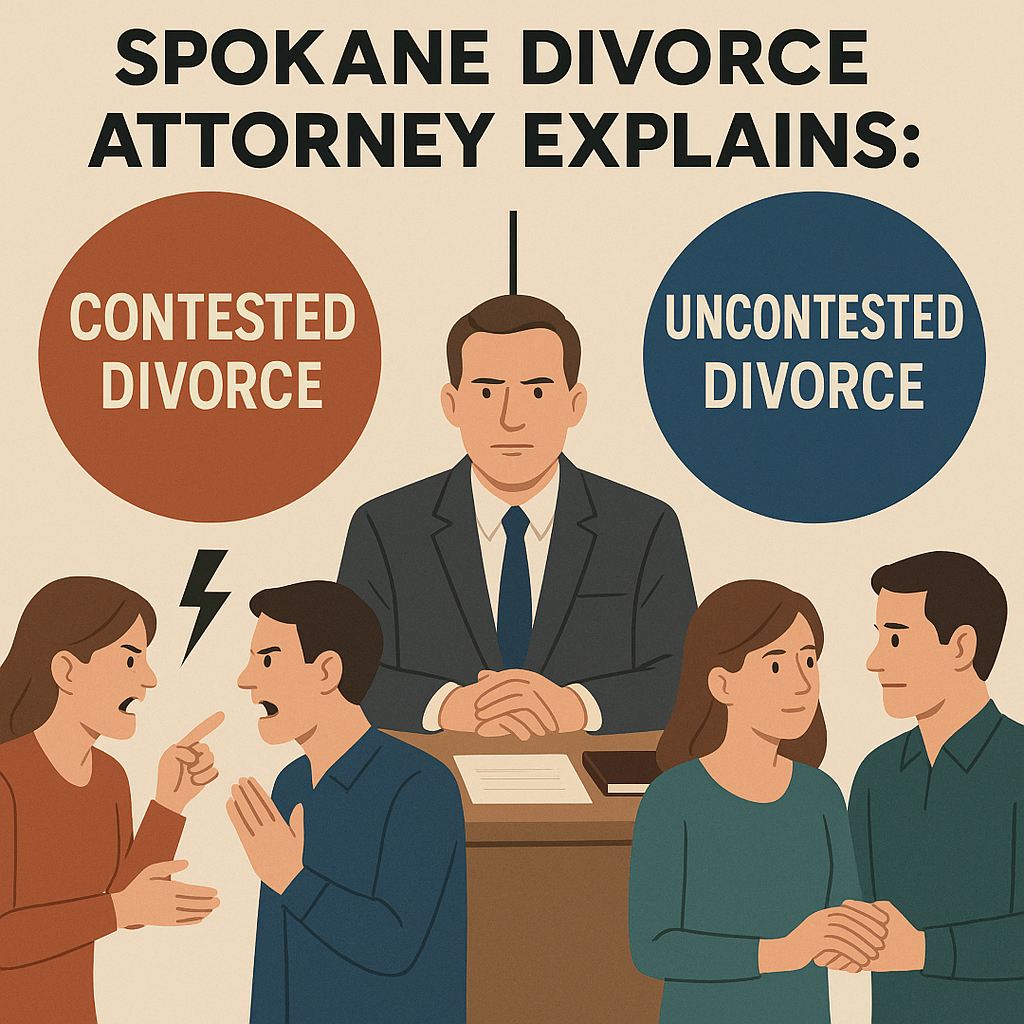
When you decide to end your marriage, one of the first questions you’ll face—and the most crucial in determining your path forward—is whether your divorce will be contested vs. uncontested divorce. A Spokane divorce attorney will tell you that this distinction is about more than just a label; it defines the entire process, impacting your timeline, financial costs, emotional strain, and ultimately, your outcome. Understanding these two paths is the first step toward reclaiming control of your future.
I. Defining the Two Paths: The Core Difference
The difference between a contested and an uncontested divorce is simple: agreement. If you and your spouse agree on all the major issues, your divorce is uncontested. If you disagree on even a single point, it becomes a contested divorce.
I.A. What is an Uncontested Divorce?
An uncontested divorce means the spouses have reached, or are confident they can reach, a full agreement on every single issue related to the dissolution of their marriage. This includes the division of all marital property and debts, child custody (referred to in some states as the parenting plan), child support, and spousal maintenance. In this scenario, the court’s role is simply to review the agreed-upon terms, ensure they comply with state law (especially concerning the best interests of the children), and sign the final orders. This path is often collaborative, quicker, and significantly less expensive.
I.B. What is a Contested Divorce?
A contested divorce occurs when the parties cannot agree on one or more material issues. This disagreement requires the intervention of the court, meaning the case will involve legal discovery, motion hearings, mediation, and potentially a full trial where a judge—rather than the spouses—makes the final, binding decisions. Contested cases are defined by a lack of consensus, whether that’s over who gets the house, the exact terms of the parenting schedule, or the amount of spousal support.
II. Key Areas of Dispute in a Contested Case
Any significant disagreement can push a divorce into the contested category. These disputes typically center on issues with profound long-term consequences.
II.A. Division of Property and Debt
In community property states, assets and debts acquired during the marriage are subject to equitable division. A contested divorce arises when the parties dispute:
- Characterization: Whether an asset is separate property (owned before marriage or received as a gift/inheritance) or community property (subject to division).
- Valuation: The true worth of complex assets like a family business, professional practice, or investment portfolio.
- Distribution: How to physically divide assets like the family home or retirement accounts without liquidating them. If you cannot agree on how to divide assets, a judge decides, which is why a skilled Spokane family law attorney is necessary to argue your financial contributions and needs.
II.B. Child Custody and the Parenting Plan
Disagreements over children are often the most emotionally charged aspect of a contested divorce. Issues typically revolve around:
- Residential Schedule: Where the children spend most of their time.
- Decision-Making Authority: Whether parents share the right to make major decisions (legal custody) or if one parent has sole authority.
- Relocation: One parent’s wish to move with the children, which requires court permission if the move will impact the other parent’s time with the children.
II.C. Spousal Maintenance (Alimony) and Child Support
While child support is generally calculated using a state-mandated formula based on income and parenting time, disputes still occur over calculating a party’s true income, especially with self-employed individuals. Spousal maintenance is much more discretionary and a common source of conflict. Contests arise over:
- Necessity: Whether one spouse needs support and whether the other can afford to pay it.
- Amount and Duration: The specific payment amount and the length of the maintenance period, which often correlates with the length of the marriage and the dependent spouse’s ability to become financially self-supporting.
III. The Uncontested Divorce: Speed, Cost, and Control
The benefits of a mutual agreement are substantial, fundamentally changing the nature of the divorce process.
III.A. Timeline and Efficiency
Uncontested divorces move swiftly through the court system, often governed primarily by the state’s mandatory waiting period. Because the court doesn’t need to schedule multiple hearings, discovery is minimal, and the judge simply reviews the final paperwork for compliance. This means families can achieve closure and move on with their lives much faster than those caught in a contested loop.
III.B. Financial Advantages
Without litigation, legal fees are dramatically lower. A contested divorce can quickly rack up thousands of dollars in costs related to filing motions, discovery requests, expert witnesses, and extended attorney time in court preparation. By avoiding these adversarial steps, an uncontested divorce allows the parties to retain more of their marital estate rather than spending it on legal battles.
III.C. Control Over the Outcome
The single greatest benefit of an uncontested divorce is that you and your spouse remain in control of the final decisions. You can craft creative solutions that a judge, bound by strict case law and limited in time, might never consider. In a contested case, you hand over control of your family and finances to a judge who is a complete stranger to your family dynamics.
IV. The Contested Divorce Process: Litigation and Discovery
If an agreement cannot be reached, the contested path is triggered, involving a series of formal, adversarial steps designed to resolve disputes through the court system.
IV.A. Formal Legal Discovery
Contested cases begin with intensive legal discovery. This phase involves formal requests for documents, sworn written questions (interrogatories), and verbal depositions where a spouse or other witness answers questions under oath. The purpose is to gather all information necessary to uncover the complete financial picture and build a case for trial. If a spouse suspects hidden assets or undisclosed income, robust discovery is essential.
IV.B. Motion Practice and Temporary Orders
The lack of agreement often necessitates immediate court intervention. Motion practice involves one attorney formally asking the court to rule on a temporary issue. The most common motions are for Temporary Orders—short-term rules governing child residency, support payments, and who gets exclusive use of the family home while the divorce is pending. These hearings can be frequent and add substantial cost and stress.
IV.C. The Role of Mediation (Even in Contested Cases)
Most courts mandate that even contested cases go through mediation before a trial date is set. In mediation, a neutral third party (the mediator) helps the spouses negotiate, encouraging compromise and attempting to resolve disputes outside of court. Mediation is often successful in resolving key issues and moving a case toward a final, agreed-upon settlement, thus preventing the high costs of a full trial.
V. Transitioning from Contested to Uncontested
It’s important to know that a contested divorce doesn’t have to end in a courtroom trial. Many contentious cases are resolved through negotiation.
V.A. The Power of Attorney Negotiation
In many instances, the attorneys themselves negotiate a final settlement agreement. After discovery is complete and all facts are known, a strategic Spokane divorce attorney can leverage the evidence collected to convince the opposing side that a settlement is preferable to the risks and costs of a trial.
V.B. Settlement Conferences
Sometimes, the parties and their lawyers meet for a formal settlement conference, occasionally with a retired judge or a judicial officer, to facilitate a compromise. These conferences are structured negotiations designed to finalize an agreement on all outstanding issues, which then allows the case to conclude as a “settled” divorce rather than a fully litigated one.
V.C. When Trial Becomes Necessary
If all attempts at negotiation and mediation fail, the case proceeds to trial. This is the most complex, costly, and time-consuming step. Both sides present evidence, examine and cross-examine witnesses, and make legal arguments to a judge, who then makes the final, binding decisions on every disputed matter.
VI. Deciding Which Path is Right for Your Family
Determining your path requires a realistic assessment of your relationship with your spouse and the complexity of your marital estate.
VI.A. The Communication Assessment
If you and your spouse can communicate respectfully and exchange financial information transparently, the uncontested route is usually the best fit. If communication is non-existent, hostile, or if one party is hiding assets or being uncooperative, the structure and protective measures of a contested divorce become necessary.
VI.B. Evaluating Case Complexity
A short-term marriage with minimal assets and no children is often ideal for an uncontested divorce. A long-term marriage with a family business, significant retirement assets, and contested parenting matters almost always requires the detailed investigation and advocacy inherent in a contested case.
VI.C. Cost Versus Control
Ask yourself which is more important: minimizing cost and maximizing control (uncontested), or ensuring every single issue is thoroughly litigated and reviewed by a judge (contested). For some, the emotional security of a court-imposed decision outweighs the significant expense.
Conclusion
Ultimately, the choice between a contested and an uncontested divorce comes down to whether you and your spouse can agree on the terms of your future. While the uncontested path offers a quicker, cheaper, and less emotionally draining exit, a contested divorce, guided by a professional and experienced Spokane family law attorney, ensures that your rights and interests are fully protected when your spouse is unwilling or unable to cooperate. Choosing the right legal strategy is the most essential step toward a stable future after divorce.