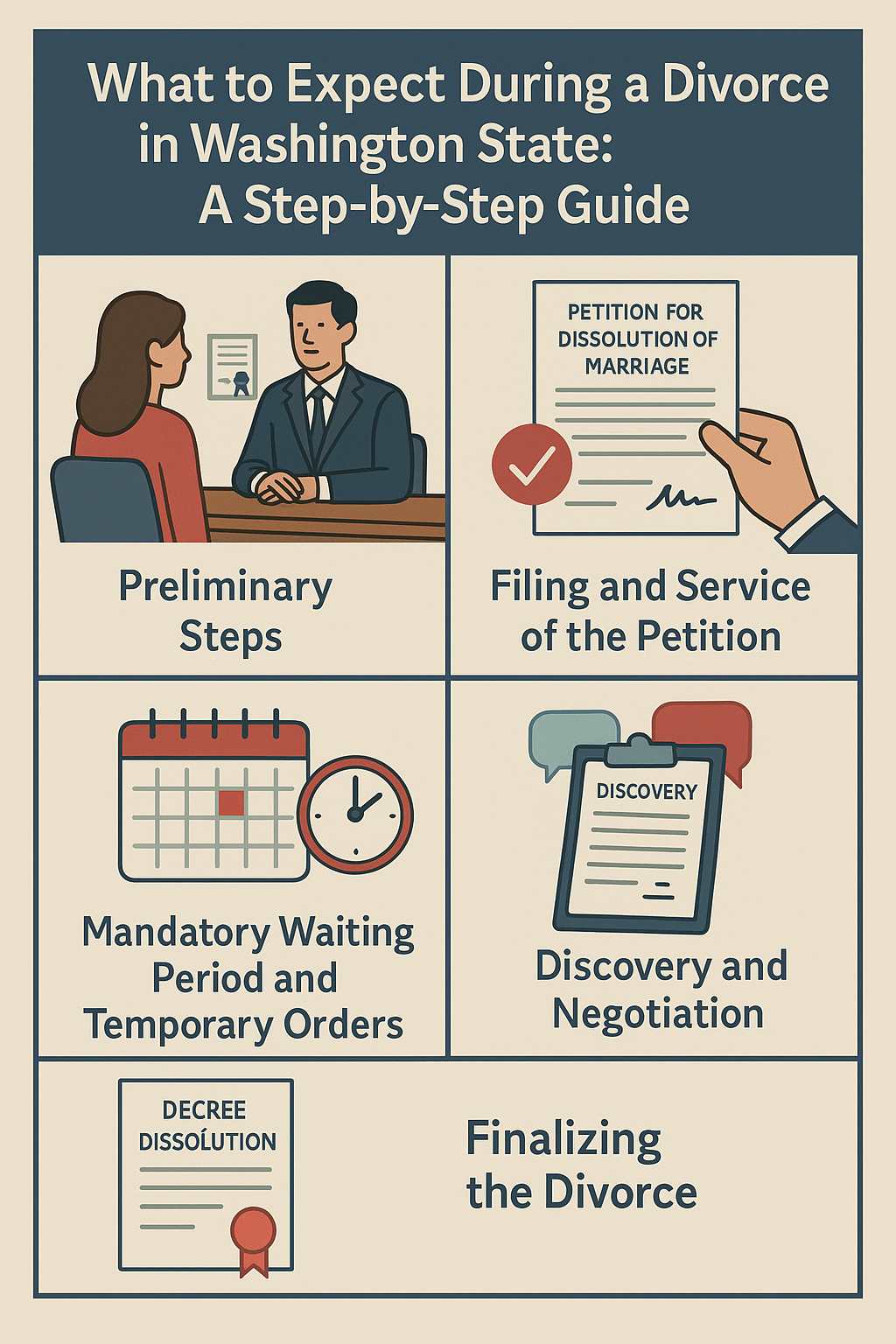
Facing a divorce is rarely easy. It’s a process that brings significant emotional and financial change. Understanding the precise legal steps you must take in Washington State can help demystify the journey and empower you to make informed decisions. Many people find their initial peace of mind by contacting a reputable divorce lawyer Spokane to discuss their particular circumstances and the path ahead. Washington operates under a clear, structured system, and knowing the process—from the initial filing to the final decree—is the best way to navigate it successfully.
I. Preliminary Steps: Establishing Grounds and Residency
Before any documents are filed, you must meet the state’s requirements and gather the necessary information. Washington is a “no-fault” state, simplifying the first stage considerably.
I.A. Meeting Washington’s Residency Requirements
Washington State has relatively lenient residency rules for divorce. To file, you or your spouse must simply reside in the state at the time of filing. Unlike many states, there is no minimum time period—such as six months or a year—that you must have lived there before initiating the action. You must, however, file the Petition for Dissolution of Marriage in the Superior Court of the county where you or your spouse lives.
I.B. Grounds for Divorce: The “Irretrievable Breakdown”
Washington is strictly a no-fault divorce state. The only legal ground required to dissolve a marriage is a sworn statement that the marriage is “irretrievably broken” and that there is no reasonable hope of reconciliation. This means you do not need to prove fault—such as adultery, abuse, or abandonment—which removes a significant source of conflict and complication from the court proceedings.
I.C. The Critical Role of Document Gathering
Before officially starting the divorce, you need to compile a comprehensive set of financial records. This process, often called financial discovery, is essential for a fair division of property and the calculation of support. These documents include:
- Tax returns (the past three to five years).
- Bank and investment account statements.
- Retirement and pension plan statements (e.g., 401k, IRA).
- Pay stubs and income verification.
- Real estate deeds, mortgages, and appraisal documents.
- Statements for all outstanding debts (credit cards, loans, etc.).
II. The Formal Filing and Service of the Petition
The divorce process officially begins when one spouse (the Petitioner) files the legal paperwork with the court.
II.A. Filing the Petition for Dissolution of Marriage
The Petition for Dissolution of Marriage is the main document. It informs the court of your requests regarding property division, debt allocation, child custody, child support, and spousal maintenance (alimony). The Petitioner must complete this form and several other mandatory documents, including a Summons and a Confidential Information Form, and submit them to the appropriate Superior Court clerk, along with the required filing fee.
II.B. Legally Notifying the Other Spouse (Service)
After filing the documents, the Petitioner must formally serve the spouse (the Respondent) with a copy of the paperwork. This must be done according to specific legal rules to ensure the Respondent has proper notice of the divorce action. Service can be completed by a third party, such as a professional process server or a sheriff. The date of service is critical because it starts the clock for the mandatory waiting period and the deadline for the Respondent to file a formal legal response.
II.C. The Respondent’s Official Response
The Respondent has a limited time to respond to the Petition: 20 days if they were served in Washington State or 60 days if served outside the state. If the Respondent fails to file a response, the Petitioner may be able to proceed by default, resulting in a Decree of Dissolution that grants everything requested in the original Petition.
III. The Mandatory Waiting Period and Temporary Orders
The period immediately following service involves a mandatory pause and, frequently, the establishment of interim rules to govern the parties’ lives.
III.A. The Mandatory 90-Day Waiting Period
Washington law mandates a minimum 90-day waiting period before a judge can sign the final Decree of Dissolution. This “cooling off” period is designed to give the couple an opportunity to reconcile or, more commonly, to finalize a settlement agreement without pressure. No exceptions exist to waive this 90-day rule. The earliest your divorce can be finalized is 91 days after the Petition was filed and the Respondent was served.
III.B. Obtaining Temporary Orders
The divorce process can take many months, and couples need rules to live by while it unfolds. Temporary Orders are short-term court mandates that govern the parties from the time of the initial filing until the final Decree. A party files a motion to request these orders, which can address:
- Residential Schedule: Which parent the children live with, and a temporary visitation schedule.
- Financial Support: Temporary child support and spousal maintenance payments.
- Use of Property: Exclusive use of the family home or a vehicle.
- Restraining Orders: Directing one party not to dispose of marital assets or incur additional debt.
IV. The Discovery and Negotiation Phase: Resolving Key Issues
The heart of the divorce process involves the exchange of information and the effort to negotiate a comprehensive settlement.
IV.A. Formal Discovery: Information Exchange
Discovery is the formal legal process where each spouse obtains information from the other. It ensures both parties have a complete picture of the marital finances and other relevant facts. This often includes formal requests for production of documents, written questions (interrogatories), and potentially sworn testimony (depositions). Diligent discovery prevents assets from being hidden and promotes a fair settlement.
IV.B. Characterizing Property: Community vs. Separate
Washington is a community property state. This means all property and debt acquired by either spouse during the marriage is considered community property and subject to “just and equitable” division. Property acquired before the marriage or received as a gift or inheritance during the marriage is considered separate property and is generally awarded to the original owner. However, separate property can be “commingled” with community funds, making it subject to division. Accurately characterizing all assets is a complex task where the guidance of an experienced attorney is vital.
IV.C. Child Custody and Parenting Plans
For couples with minor children, the court’s priority is the best interests of the child. Instead of “custody,” Washington uses the term Parenting Plan, which addresses three main areas:
- Residential Schedule: Where the children live and when they spend time with each parent.
- Decision-Making: How parents will make major decisions (education, health, religious upbringing).
- Dispute Resolution: A method for resolving future disagreements. The court encourages parents to agree on a plan, and both parents are often required to attend a Mandatory Parent Education Program to learn about the effects of divorce on children.
IV.D. Child Support and Spousal Maintenance
Child support is calculated using the Washington State Child Support Schedule, which is primarily driven by both parents’ incomes and the number of overnight visits the children spend with each parent. Spousal Maintenance (alimony) is not automatic and is determined based on factors like the length of the marriage, the financial needs of one spouse, and the ability of the other spouse to pay. The longer the marriage, the more likely maintenance will be awarded. Navigating the state’s complex child support guidelines and arguing for or against maintenance requires an astute legal mind.
IV.E. Negotiation and Mediation
Most cases resolve through direct negotiation between the parties and their lawyers or through mediation, where a neutral third-party mediator helps the couple find common ground. This is usually faster, less expensive, and gives the parties more control over the outcome than a trial. If you are struggling with this phase, it’s beneficial to have a family law attorney Spokane assist with the negotiations, as their knowledge of local judicial tendencies can inform your strategy.
V. Finalizing the Divorce: Entering the Decree
If a settlement is reached or after a contested trial, the case culminates in the entry of a final judgment.
V.A. The Final Settlement or Trial
If the parties reach a full agreement on all issues (property, debt, parenting, support), their attorneys draft a Settlement Agreement and a set of Final Orders. If no agreement is reached, the case proceeds to trial, where a judge hears all the evidence and testimony and makes the final, binding decisions on all outstanding issues.
V.B. The Decree of Dissolution of Marriage
This is the final, legally binding document that formally ends the marriage. It incorporates all the terms of the settlement or the judge’s ruling. It outlines the final division of property and debt, the permanent parenting plan, and all support obligations. Once the judge signs the Decree, and the 90-day waiting period has elapsed, the marriage is legally dissolved.
V.C. Post-Decree Actions
While the marriage is over, legal work may remain. This includes legally transferring property titles, updating wills and trusts, changing bank accounts, and formally executing Qualified Domestic Relations Orders (QDROs) to divide retirement assets without tax penalty. These steps ensure that the terms of the Decree are properly enforced.
Conclusion
A divorce in Washington State follows a logical, step-by-step progression, marked by mandatory timelines and clear legal requirements designed to prioritize fair resolution. The process, from the initial Petition to the final Decree, can be emotionally and logistically challenging, but understanding the legal roadmap is the first step toward reclaiming control of your future. A skilled legal partner is invaluable, transforming a confusing collection of forms and procedures into a manageable strategic plan, ensuring your best interests are protected as you transition into a new chapter of life.